Inquire

Showing posts with label HL1. Show all posts

02 May 2014

The week ahead in IB Global Politics

Image (c) 2014 New York Times

IB Glopo HL1
5 May: Finish discussion of Kaufmann, C. (1996). Possible and Impossible Solutions to Ethnic Civil War. International Security, 20(4), 136-175. Prep for simulation, Bamara Border Dispute
6 May: Simulation & debrief, Bamara Border Dispute
8 May: Read, Byman, D. (2002). Dilemmas and choices. In Keeping the peace: Lasting solutions to ethnic conflicts (pp. 213-225). Baltimore, MD: Johns Hopkins University Press.
9 May: Play, Review Roulette with Byman (2002)


In addition, you should be reading the following articles outside of class this week: Stearns, J. (2013). Helping Congo help itself. Foreign Affairs. Retrieved September/October, 2013, from http://www.foreignaffairs.com/articles/139648/jason-stearns/helping-congo-help-itself?; Stearns, J. (2013, November 11). Congo's sudden calm. Retrieved from http://www.foreignaffairs.com/articles/140255/jason-stearns/congos-sudden-calm

IB Glopo HL2
5 May: Current Events; CFR: The World Next Week
6 May: Current Events; BBC: Global News
8 May: Mock Paper 2-Development
9 May: Review and debrief on Paper 2

01 May 2014

US warns of South Sudan genocide

  
Images (c) BBC News

US warns of South Sudan genocide. (2014, May 1). Retrieved from http://www.bbc.com/news/world-africa-27245641 

A great and timely article on identity-based conflict in South Sudan. Be sure to read this tonight, before tackling Kaufmann, C. (1996). Possible and Impossible Solutions to Ethnic Civil War. International Security, 20(4), 136-175 tomorrow in class. What does Kaufmann's theory tell us about the conflict in South Sudan? What sort of policy options are available to political elites in South Sudan/in regional capitals/around the world?


28 April 2014

IB Glopo HL1: Calendar for the next two weeks

'afternoon folks,

As promised, here is the revised schedule we put together in this morning's class. I've also enclosed a general schedule of readings to be done outside of class over the next two weeks. I know that this seems like a lot, and it is, but having a command of this source material will leave you well positioned for completing your practice HL Extension Task that will serve as your summative assessment for the year.

Calendar
29 April: Watch & debrief, Kony, M23, and the real rebels of Congo
1 May: Read Kaufmann, C. (1996). Possible and Impossible Solutions to Ethnic Civil War. International Security, 20(4), 136-175.
2 May: Play, Grab That Spoon! with Kaufmann (1996)

5 May: Prep for simulation, Bamara Border Dispute
6 May: Simulation & debrief, Bamara Border Dispute
8 May: Read, Byman, D. (2002). Dilemmas and choices. In Keeping the peace: Lasting solutions to ethnic conflicts (pp. 213-225). Baltimore, MD: Johns Hopkins University Press.
9 May: Play, Review Roulette with Byman (2002)

Readings


10 April 2014

IB Global Politics: the weeks ahead, 12-27 April

'evening folks,

Here is the general outline of coursework for the next two weeks. Again, I will be in Costa Rica from 17-26 April. Before you ask, I have promised Molly that I will not bring my computer with me for this trip. So no, I won't be checking emails or on Twitter (well, maybe...a little) while we're away. I will be relaxing and reading (this, this, and this) in a hammock in the rainforest, at the beach, or otherwise lounging about in the happiest place on earth. Here's a few things to keep you busy while we're apart:

HL2: Complete the IB Global Politics Examination Review
This document is the only thing that you should work in class on from the 11th through the 27th. You'll have roughly 9 hours of class time in addition to any other time you spend outside to get this done. There's really no reason why you won't be able to complete this task in your teams. We'll have time to walk through three (3) mock Paper 2s, including debriefing and assessment, between the time I return and your IB exam. Failing to complete the Examination Review will leave you unprepared for your IB Global Politics HL exam on 21 & 22 May.

HL1: International Security in the Democratic Republic of Congo.
We'll use the next two weeks to complete our first HL extension task; International Security in the DRC. Please refer to this document to guide you through your inquiry over the next two weeks while I am away. My best advice for you, and we'll flesh this out in class over the next few days, is for you to form study groups to read, listen, & watch as many of the sources in the bibliography during the next two weeks (the Gambino report as well as some of the reports from the Rift Valley Institute are pretty heavy lifting). We'll start work on developing research questions when I return, as well as to delve into some deeper theory and simulations on the nature of civil wars and identity-based conflict.

07 April 2014

IB Global Politics: #Rwanda20


Today marks the 20th anniversary of the Rwandan genocide. While there are a plethora of great stories that have come out in recent days, these stood out as some of the most compelling, informative, or provocative. Please take the opportunity to read, listen, and reflect on these, especially if you're revising for exams or preparing for tomorrow's simulation.

The Economist. (2014, April 05). To hell and back. Retrieved from http://www.economist.com/news/international/21600156-how-nations-torn-apart-atrocity-or-civil-war-can-stitch-themselves-together-again?fsrc=scn%2Ffb%2Fwl%2Fpe%2Ftohellandback

Fritz, M. (1994, May 13). Only human wreckage is left in village of Karubamba. Retrieved from http://www.pulitzer.org/archives/5701

Gourevitch, P. (2014, April 4). Letter from the archive: The genocide in Rwanda. Retrieved from http://www.newyorker.com/online/blogs/backissues/2014/04/letter-from-the-archive-the-genocide-in-rwanda.html

Human Rights Watch. (1999, March). Leave none to tell the story: Genocide in Rwanda. Retrieved from http://www.hrw.org/legacy/reports/1999/rwanda/Geno15-8-01.htm

Inskeep, S. (2014, April 7). Where does Rwanda go from here? Retrieved from http://www.npr.org/2014/04/07/300118525/where-does-rwanda-go-from-here

Kagame, P. (2014, April 1). Rebooting Rwanda. Retrieved from http://www.foreignaffairs.com/discussions/interviews/rebooting-rwanda

Warner, G. (2014, April 6). How abandonment in Rwandan genocide changed peacekeepers' role. Retrieved from http://www.npr.org/2014/04/06/299913830/how-abandonment-in-rwandan-genocide-changed-peacekeepers-role

Warner, G. (2014, April 7). Ceremonies commemorate 20 years since Rwanda genocide. Retrieved from http://www.npr.org/2014/04/07/300118518/ceremonies-commemorate-20-years-since-rwanda-genocide

Wolfe, L. (2014, April 04). How Rwandans cope with the horror of 1994. Retrieved from http://www.theatlantic.com/international/archive/2014/04/how-rwandans-cope-with-the-horror-of-1994/360204/

Tomorrow, the Glopo Year 1 students will take part in a day long simulation on peace building in post-genocide Rwanda. One village, six people gives students the opportunity to explore and apply their understanding of the concepts power, legitimacy, sovereignty, interdependence, peace, non-violence, conflict, and violence as they take on various roles of victims and perpetrators of the Rwandan genocide. I'll be sure to post pictures and reflections, including our #Rwanda20 selfie, on the experience after we've completed our debriefing.

04 April 2014

IB Global Politics: The Week Ahead, 7-11 April


afternoon all,

The next week will mark the 20th anniversary of the start of the Rwandan genocide. If you get the chance, please read an extraordinary interview with Rwandan President Paul Kagame in Foreign Affairs as well as a great read in The Atlantic, "How Rwandans Cope with the Horror of 1994." We're also a whole 7 weeks away from the first IB Glopo exams (whoo hoo!).  Be sure to go out and support your colleagues in The Crucible this weekend; cast, break a leg! Here's our schedule for next week.

Glopo HL1
Glopo HL2


28 March 2014

IB Global Politics: the week ahead, 31 March through 4 April


HL1: The Politics of Peace and Conflict, the Rwandan Genocide


 HL2: Revise for IB Global Politics examination

24 March 2014

Playing 4Cs with The Causes of Internal Conflict (Brown 1997) in IB Global Politics

Today's class featured a synthesis & debriefing activity from one of my favorite introductory readings on internal conflict, Brown, M. E. (1997). The causes of internal conflict. In Nationalism and ethnic conflict (pp. 3-25). Cambridge, MA: MIT Press. I've used the Brown chapter in a high school setting for many years; whether it was for IB History, our before-school seminar on the Causes of War and Peace, Comparative Genocide, and now in IB Global Politics. I've always found that students rise to the occasion and have a go at readings such as this when you engage the students with challenging material (I only tell them afterwards about the context and audience for these types of readings) in a supportive environment where we get to discuss, analyze, and unpack authors' ideas. I've had more than a few students go on to undergraduate and grad school programs in IR and PoliSci who will write to me saying something to the effect of, "XYZ article is on the syllabus this term. I was was the only one in the class who understood this because we read it together in high school." Besides, its always fun to go back and review articles, chapters, and books I found so meaningful when I had the luxury of studying IR full time. 

We used a modified version of Thagi's 4Cs activity to apply our understanding of the Brown reading in a jigsawed context. Students were grouped into 4 teams and asked to develop a team understanding of what are the components, characteristics, challenges of, or characters in internal conflict. Once the table consensus had been reached, team members then interviewed their colleagues from other groups in order gather their ideas on the respective topics. Finally, groups reconvened in their original teams to provide a synthesis statement regarding their understanding of their assigned categories.


I would certainly use this activity again, although it really should be run in a class period that lasts more than an hour. I also think that while 4Cs was an effective vehicle for students to connect their understanding of Brown (which we read in class on Friday & over the weekend) as well as their other readings, the activity could also be used to extend students' understanding of source material (text or video) or as an introductory exploration of a topic prior to a simulation, investigation, or interaction with course material. 

21 March 2014

IB Global Politics: the week ahead, 24-28 March

'afternoon folks,

Here's the brief outline for next week-have a restful weekend.

Higher Level 2
HL2 folks; if you're going to make final edits to your IAs before submission and marking, please do so this weekend. Your IA scores will be uploaded to IBIS no later than Tuesday. Those IAs which are headed out for external review will be mailed out by Friday the 28th. Finally, I have the study groups listed as follows: (Devon, Jessie, Coby, Evan); (Zach); (Ilana, Jonathan, Lauren); (Max, ATD, Daniel, Jack); (Michael); (Ryan, Nathalia, Camilo). Please be sure you are making adequate progress towards completing your study guide. Your first Mock Paper 2 on the Power, Sovereignty, and International Relations unit will be on Tuesday, 1 April 2014.

Higher Level 1
Just a reminder that Tuesday's post-simualtion survey will serve as the data collection for my dissertation. Also, I'll be sending you and your parents a permission slip for our day-long simulation, One Village, Six People for Tuesday the 8th of April. We'll use this as the engagement activity for your IB Internal Assessment; more information on this will be explained in class later this week. 

20 March 2014

IB Global Politics: Academic Conference Call, "Update on the Congo"

(c) 2014 Council on Foreign Relations

When? Wednesday, 26 March from 12 to 1pm.
Where? Room 101.
What do I have to do? Comment on this blog post to confirm your attendance (HL 1 folks, this call should be mandatory) no later than Monday 24 March. I will make the arrangements with your advisors, etc. Please be sure to read & review the links below. You'll also want to plan on bringing your lunch to the classroom. Finally, please prepare at least one discussion question from the readings for us to work through in class OR to ask Mr. Stearns on the call.

Our next Academic Conference Call with the Council on Foreign Relations will undoubtedly be the best one yet. Jason Stearns, director of the Usalama Project at the Rift Valley Institute, will discuss the Democratic Republic of the Congo (DRC). Prior to the Rift Valley Institute, Mr. Stearns worked for the International Human Rights Law Group and the United Nations peacekeeping operation Organization Stabilization Mission in the Democratic Republic of the Congo (MONUC). Between 2005 and 2007, he was based in Nairobi, Kenya, as a senior analyst for the International Crisis Group, where he worked on the DRC, Rwanda, and Burundi. In 2008, he was appointed by the UN Secretary General as coordinator of the UN Group of Experts on the Congo, which researches the support and financing of armed groups in the eastern DRC. He is currently working on a PhD in political science at Yale University, and is author of the book Dancing in the Glory of Monsters: The Collapse of the Congo and the Great War of Africa (New York: Public Affairs, 2011); a book that is on my summer reading list this year.

As background for the discussion, you will want to read and review the following:


04 March 2014

IB Global Politics: reviewing policy options to address Iran's nuclear program

As we head into the final stretch of our coverage of the politics of nuclear proliferation, the Year 1 students were asked to review and evaluate the policy options available to the US and the rest of the international community with respect to Iran's nuclear program. Based on our readings and discussion, as well as all of the content from the CFR's Iran: Crisis Guide, students rank ordered their preferences for US action towards Iran: Covert Action, Diplomacy, Opposition Support, Preventative Strike, Public Diplomacy, and Sanctions. 


As you can see from the charts above, there is strong preferences amongst the Year 1 students for pursuing diplomacy, traditional and public. Interestingly, while there is generally opposition to both covert action and using force in a preventative strike, although roughly 1 in 4 students support the use of force, there is also general support for ending economic sanctions against Iran as well. These preferences shouldn't simply be interpreted as the naiveté of young minds; a review of the assigned readings and content in the bibliography below is worthy (in my humble opinion) of belonging in a university setting. Rather, I interpret the student's preference for diplomacy over other policy options towards Iran as stemming from a shrewd consideration of the available costs and benefits of all policy options available to the US, given the dynamics of the current geopolitical environment. 

As with the Year 2 students work last year, we'll wrap up this unit by simulating a crisis decision-making situation with the Truman National Security Project's simulation, Tell Me How This Ends. This simulation gives students the opportunity to manage their own US administration through a simulated strike on Iran's nuclear facilities. The debrief on this simulation is always interesting and informative. This year will be no different as I am collecting data for my doctoral dissertation, via student survey responses, as to the degree to which they perceive Tell Me How This Ends as an engaging activity towards learning the prescribed concepts and learning outcomes in our IB Global Politics course.   

As always, special thanks to the folks at the Council on Foreign Relations, the CFR's Academic Initiative, the Truman National Security Project, and of course the International Baccalaureate for supporting the work of high school students and their study of international politics. 

You can see all of the related blog posts and evidence of work in class here. The complete bibliography for this section of the course is below. 

Allison, G. (2010, January/February). Nuclear disorder: Surveying atomic threats. Foreign Affairs. Retrieved from http://www.foreignaffairs.com/articles/65732/graham-allison/nuclear-disorder?nocache=1 

Bruno, G. (2010, March 10). Iran's nuclear program. Council on Foreign Relations. Retrieved from http://www.cfr.org/iran/irans-nuclear-program/p16811 

Council on Foreign Relations. (2009). Nuclear energy guide. Retrieved from http://www.cfr.org/interactives/IG_Nuclear/index.html#/overview/

Council on Foreign Relations. (2012). Crisis guide: Iran. Retrieved from http://www.cfr.org/interactives/CG_Iran/index.html?cid=oth-redirect-crisis_guide_iran  

Council on Foreign Relations. (2013). Nuclear proliferation. Global Governance Monitor. Retrieved from http://www.cfr.org/global-governance/global-governance-monitor/p18985#!/nuclear-proliferation 

Council on Foreign Relations. (2013, June 25). The global nuclear nonproliferation regime. Retrieved from http://www.cfr.org/arms-control-disarmament-and-nonproliferation/global-nuclear-nonproliferation-regime/p18984 

Director General, International Atomic Energy Association. (2012, February 24). Implementation of the NPT Safeguards Agreement and relevant provisions of Security Council resolutions in the Islamic Republic of Iran (Rep.). Retrieved http://isis-online.org/uploads/isis-reports/documents/IAEA_Iran_Report_24February2012.pdf 

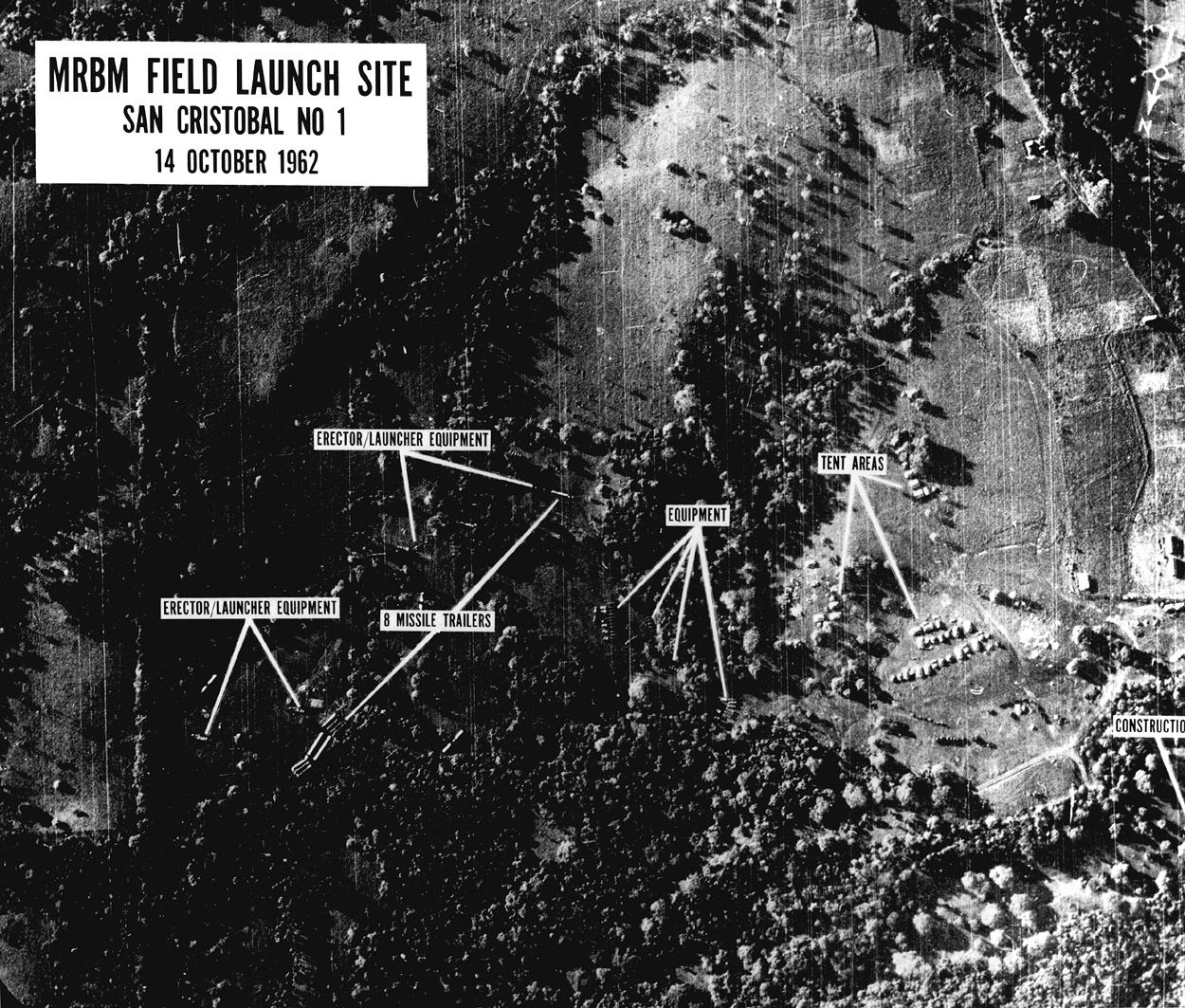
Donaldson, R. (Director). (2000). Thirteen days [Motion picture on DVD]. United States: New Line Cinema.

Gordon, M. R., & Schmitt, E. (2014, January 12). Negotiators put final touches on Iran accord. New York Times. Retrieved from http://www.nytimes.com/2014/01/13/world/middleeast/iran-nuclear-deal.html 

Iran nuclear deal: key points. (2014, January 20). BBC News. Retrieved from http://www.bbc.co.uk/news/world-middle-east-25080217

Kahl, C. (2012). Not time to attack Iran. Foreign Affairs. Retrieved from http://www.foreignaffairs.com/articles/137031/colin-h-kahl/not-time-to-attack-iran 

Kahl, C. H. (2014, January 7). Still not time to attack Iran. Foreign Affairs. Retrieved from http://www.foreignaffairs.com/articles/140633/colin-h-kahl/still-not-time-to-attack-iran 

Kegley, C. W., & Raymond, G. A. (2012). Foreign policy decision making. In The global future: A brief introduction to world politics (5th ed., pp. 55-79). Boston, MA: Wadsworth/Cengage Learning. (link)

Kroenig, M. (2012). Time to attack Iran. Foreign Affairs. Retrieved from http://www.foreignaffairs.com/articles/136917/matthew-kroenig/time-to-attack-iran 

Kroenig, M. (2014, January 7). Still time to attack Iran. Foreign Affairs. Retrieved from http://www.foreignaffairs.com/articles/140632/matthew-kroenig/still-time-to-attack-iran 

Q&A: Iran nuclear crisis. (2014, January 20). BBC News. Retrieved from http://www.bbc.co.uk/news/world-middle-east-11709428

Rezaian, J. (2014, February 4). In Iran, opponents of a nuclear deal speak up. Washington Post. Retrieved from http://www.washingtonpost.com/world/opponents-of-nuclear-deal-in-iran-speak-up/2014/02/04/08aa47c6-8d9a-11e3-99e7-de22c4311986_story.html 

Rouhani: Iran is getting nuclear deal benefit. (2014, February 6). Al Jazeera. Retrieved from http://www.aljazeera.com/news/middleeast/2014/02/rouhani-iran-getting-nuclear-deal-benefit-20142684048867466.html

Sagan, S. D. (2006). How to keep the bomb from Iran. Foreign Affairs. Retrieved from http://www.foreignaffairs.com/articles/61915/scott-d-sagan/how-to-keep-the-bomb-from-iran 

Waltz, K. N. (2012). Why Iran should get the bomb. Foreign Affairs. Retrieved from http://www.foreignaffairs.com/articles/137731/kenneth-n-waltz/why-iran-should-get-the-bomb  

Zengerle, P., & Mohammed, A. (2014, February 04). Iran nuclear deal 'not perfect' but buys time, top U.S. official. Reuters. Retrieved from http://www.reuters.com/article/2014/02/04/us-nuclear-iran-sherman-idUSBREA1312020140204 

03 March 2014

IB Global Politics: debating policy options on Iran's nuclear program.

Crisis Guide: Iran


A busy day so far in IB Glopo, but as we can see from the world outside the classroom, world politics is like this some times. HL1 folks; please take a moment and rank your preferences for the different policy options available to the US as seen in the videos and with the discussion from today's class.


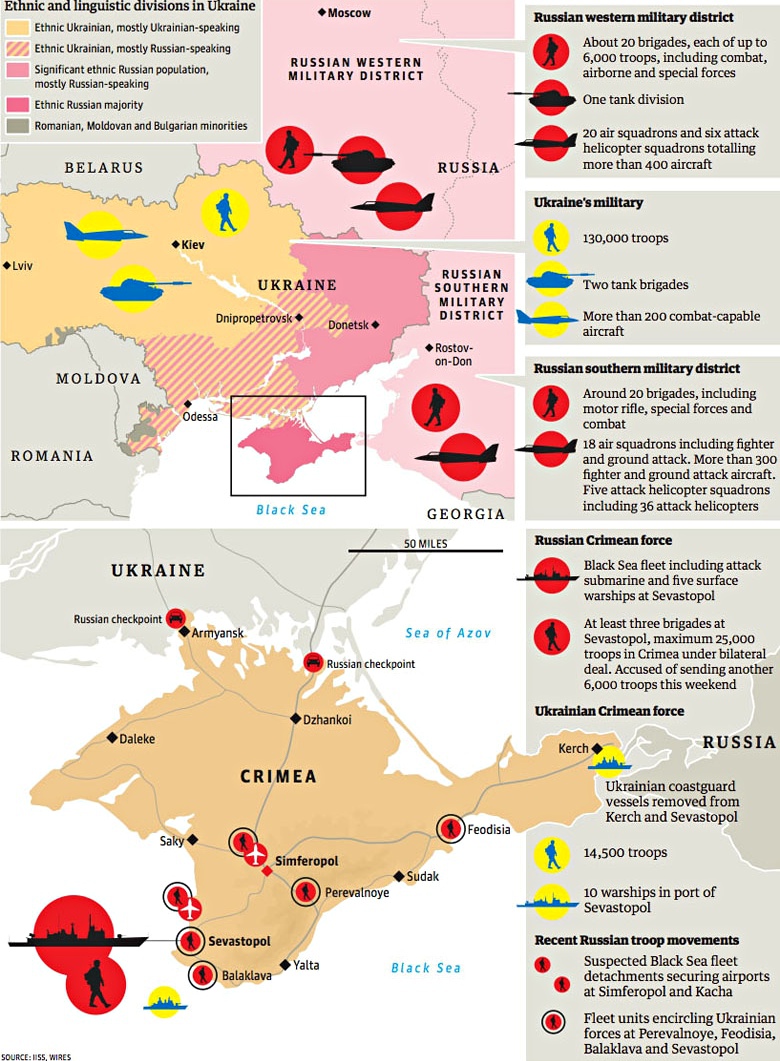
IB Global Politics: (more) readings and resources on Crimea

via Russia and Ukraine: The military imbalance. (2014, March 03). The Guardian. Retrieved from http://www.theguardian.com/world/graphic/2014/mar/03/russia-ukraine-military-imbalance-graphic

Live coverage and background
 Ukraine crisis. (2014). BBC News. Retrieved from http://www.bbc.com/news/world-europe-26413953

Analysis
Coalson, R. (2014, February 28). The Crimean crisis we should have seen coming. The Atlantic. Retrieved from http://www.theatlantic.com/international/archive/2014/02/the-crimean-crisis-we-should-have-seen-coming/284153/ 
Friedman, U. (2014, March 3). Putin's playbook: The strategy behind Russia's takeover of Crimea. The Atlantic. Retrieved from http://www.theatlantic.com/international/archive/2014/03/putins-playbook-the-strategy-behind-russias-takeover-of-crimea/284154/ 
Giles, K. (2014, March 3). Russia will take whatever it can. Chatham House. Retrieved from http://www.chathamhouse.org/media/comment/view/197798?dm_i=1TY5,28GN2,BHZIAT,83C7G,1 
Hudson, J. (2014, March 3). White house considering sanctions measures against Russia. Foreign Policy. Retrieved from http://thecable.foreignpolicy.com/posts/2014/03/03/white_house_considering_sanctions_measures_against_russia 
Maness, R., & Valeriano, B. (2014, March 3). Russia's coercive diplomacy against Ukraine: The power politics story. Duck of Minerva. Retrieved from http://www.whiteoliphaunt.com/duckofminerva/2014/03/russias-coercive-diplomacy-against-ukraine-the-power-politics-story.html 
Marvin, T. (2014, March 3). The crisis in Crimea. Political Violence at a Glance. Retrieved from http://politicalviolenceataglance.org/2014/03/03/the-crisis-in-crimea/ 
McMahon, R. (2014, March 01). Issue guide: Crisis in Ukraine's Crimea. Council on Foreign Relations. Retrieved from http://www.cfr.org/ukraine/issue-guide-crisis-ukraines-crimea/p32516 
Motyl, A. J. (2014). How far will Putin go? Foreign Policy. Retrieved from http://www.foreignpolicy.com/articles/2014/03/01/putin_russia_ukraine_intervention_war
Mycio, M. (2014, March 1). Vladimir Putin Is miscalculating how easy it will be to control Crimea. Slate Magazine. Retrieved from http://www.slate.com/articles/news_and_politics/foreigners/2014/03/vladimir_putin_s_crimean_mistake_the_russian_president_is_miscalculating.html 


IB Global Politics: End of term survey.

'morning folks,

With the end of term rapidly approaching and grades due on Monday the 10th, its time once again for you to offer your own detailed feedback and reflection on your learning experience in IB Global Politics this term. Please feel free to fill out this form during the week. We will also have class time in our abbreviated session on Friday for your to fill this out. As always, please be sure that you're taking the time to construct thoughtful, detailed responses to the prompts in the survey. The feedback and self-analysis that you provide is a tremendously powerful set of information for us to work with.

01 March 2014

IB Global Politics: The Week Ahead, 3-7 March


Kupchan, C. A. (Director). (2014, March 1). Ukraine's road ahead: Three things to know [Video]. Retrieved from http://goo.gl/rWlojH 

 'afternoon folks,

Well, the last 24 hours in world politics have been interesting to say the least. Be sure that you're checking in with the usual suspects (CFR, Foreign Policy, The Economist, BBC News, NPR, UN News Centre, and more) for news and analysis on what's transpiring in Ukraine. Alternatively, you can also follow events live from the following (I'll add more regularly)


Higher Level 1

Essential Question
To what extent is the proliferation of nuclear energy, weapons, and related technologies a geopolitical challenge?

Key Concepts
Power, Sovereignty, Legitimacy, Interdependence, Peace, Conflict, Violence, Nonviolence

Theoretical Foundations
Realism, Liberalism, Constructivism

Learning Outcomes and Prescribed Content

  • The distribution, recognition and contesting of power at various levels of global politics
    • Definitions of power; Theories of power; Types of power
  • The operation and legitimization of state power in global politics
    • States and statehood; The role of institutional contexts for operation and legitimization of state power
  • The function and impact of international organizations and non-state actors in global politics
    • Definition of civil society; International organizations, including the United Nations (UN); Non-governmental organizations (NGOs), multinational corporations (MNCs) and trade unions; Social movements, resistance movements and violent protest movements
  • The nature and extent of interactions in global politics
    • Global governance; Cooperation: treaties, collective security, strategic alliances, informal cooperation; Conflict: interstate war, intrastate war, terrorism, strikes, demonstrations
For the Week


Higher Level 2
Monday through Friday: This is your final week to research, outline, perform, and/or submit your HL Extension Tasks. Please note that the last day to submit HL Extension Tasks is Friday 7 March. Third term is reserved entirely for revising towards the inaugural IB Global Politics exam as well as tying up any loose ends in the course, the IB Program, and your high school career. 

24 February 2014

Reflecting on Paper 1 in IB Global Politics

IB assessments are challenging. In contrast to other externally assessed courses which are offered in the US where students are rewarded by guessing right on multiple choice questions and manufacturing structured responses without any regard for analysis, synthesis, or style, assessments in IB courses dare students to write, to speak, to demonstrate, and to argue their ideas in variety of ways. IB courses the social sciences (Individuals and Societies) generally offer two types of written, paper-based assessments. In IB Global Politics, Paper 1 is a source (stimulus) based paper that tests student's knowledge and understanding of relevant source material; their ability to analyse relevant material and provide supporting examples; compare and contrast relevant source material and organize this material into a clear, logical, coherent and relevant response; and  compare and evaluate source material in order to synthesize and evaluate evidence from both sources and background knowledge of key issues and concepts in global politics in a clear, logical, coherent and relevant response.

The Year 1 student's process with Paper 1 began with a slow and steady introduction to both the formatting of the question as well as strategies on how to develop responses to the four questions that make up Paper 1. Rather than simply giving a "mock" Paper 1, marking-or worse yet, grading it-the students had the opportunity to read the feedback I wrote for each of their papers before providing their own reflections on the process by completing a debriefing survey. This process of reflection allowed students the time and space to articulate what they felt went well during their first Paper 1, to identify the areas where they felt they could improve, as well as to provide me with feedback about how our learning during this process could be improved the next time. Many students wrote that since they now felt comfortable with with answering the Paper 1, they would be interested in practicing it in a much more formal sense; timed writing, not having the mark scheme available for them to refer to during the process, as well as using the process of marking as a debriefing session.

If its not apparent by now, let me be blunt: I value student engagement and agency in constructing and participating in our learning over scoring high marks on a single test. In fact, I contend that combining the practice of empowering students along with long-term thinking about learning and practicing with challenging content and assessments does more to build a student's intellect and durable skill sets than ersatz high-stakes tests artificially administered at the end of the week, a chapter, or a marking period.

And now, the data....

Students were asked to report, "How would you rate the quality of your work towards each of the Assessment Objectives in your Paper 1?" according to the four Assessment Objectives covered in Paper 1: Demonstrate knowledge and understanding; Demonstrate application and analysis of knowledge and understanding; Demonstrate synthesis and evaluation; and Select, use and apply a variety of appropriate skills and techniques. A student could rank herself according to the following scale for each of the assessment objectives: very poor, poor, acceptable, good, very good. The following charts offer a summary of the students' responses to the survey (N=18)


Year 1 students in IB Global Politics reported that their responses to the Paper 1 were generally above the midpoint on the scale. The modal response to all of the questions was "good" (43%), followed by "very good" (33%), "acceptable" (21%) and "poor" (3%). Most students felt that they had a good sense of the knowledge and understanding necessary to answer the demands of the questions for Paper 1. In contrast, students expressed the broadest range of opinions when it came to the self-assessment of their approach to using skills and techniques in Paper 1. Put another way, students report that they are less confident in their ability to successfully operate the mechanics of Paper 1 than they are in the information that is relevant to the assessment itself. This finding is consistent with anecdotal responses from the students themselves; many of whom are enthusiastically anticipating working on another Paper 1. 

I don't think that its too much of stretch to say that the students' eagerness stems more from a genuine interest in having the opportunity to successfully demonstrate their knowledge than a concern about "not doing well" on a test. More importantly, this data directs both the students and I to focus on different tasks the next time we tackle a Paper 1. At that time, we'll (a) review the data from this survey, (b) ask students to review their individual responses to this survey, and (c) incorporate student recommendations to write a Paper 1 in a timed session where we mark and debrief their work in a subsequent class period. Now, if only all learning took place in such a deep, constructive, and empowering environment...

21 February 2014

IB Global Politics: The week ahead, 24-28 February.


Crisis Guide: Iran


HL2: Higher Level Extension Tasks


Monday through Friday: We'll begin the process of developing your second HL extension task. Please begin by completing another column on the HL Extension Tracking Form by the end of the day on Tuesday. The rest of the week is yours to begin your research. Please remember that you must choose a question & then research area that is different from first HL extension. Please note that the last day to submit HL Extension Tasks is Friday 7 March. Third term is reserved entirely for revising towards the inaugural IB Global Politics exam as well as tying up any loose ends in the course, the IB Program, and your high school career. 


HL1: The politics of nuclear proliferation


Essential Question
To what extent is the proliferation of nuclear energy, weapons, and related technologies a geopolitical challenge?

Key Concepts
Power, Sovereignty, Legitimacy, Interdependence, Peace, Conflict, Violence, Nonviolence

Theoretical Foundations
Realism, Liberalism, Constructivism

Learning Outcomes and Prescribed Content
  • The distribution, recognition and contesting of power at various levels of global politics
    • Definitions of power; Theories of power; Types of power
  • The operation and legitimization of state power in global politics
    • States and statehood; The role of institutional contexts for operation and legitimization of state power
  • The function and impact of international organizations and non-state actors in global politics
    • Definition of civil society; International organizations, including the United Nations (UN); Non-governmental organizations (NGOs), multinational corporations (MNCs) and trade unions; Social movements, resistance movements and violent protest movements
  • The nature and extent of interactions in global politics
    • Global governance; Cooperation: treaties, collective security, strategic alliances, informal cooperation; Conflict: interstate war, intrastate war, terrorism, strikes, demonstrations
For the week

20 February 2014

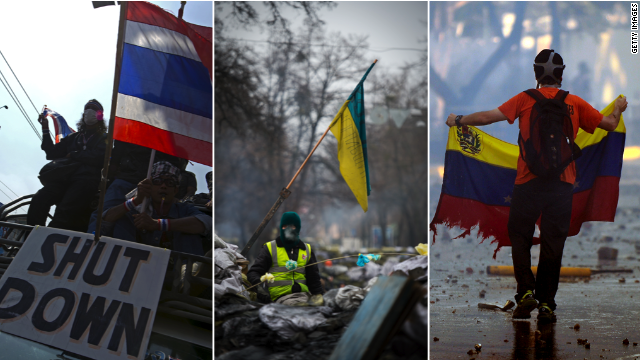
IB Global Politics: A primer on protests in Thailand, Ukraine, and Venezuela.


  1. Calamur, K. (2014, February 19). 4 Things To Know About What's Happening In Ukraine. NPR. Retrieved from http://www.npr.org/blogs/parallels/2014/02/19/279673384/four-things-to-know-about-whats-happening-in-ukraine
  2. Growing instability in Thailand. (2014). Council on Foreign Relations. Retrieved from http://www.cfr.org/global/global-conflict-tracker/p32137#!/?marker=31
  3. Kurlantzick, J. (2014, February 20). Behind a pattern of global unrest, a middle class in revolt. Business Week. Retrieved from http://www.businessweek.com/articles/2014-02-20/behind-a-pattern-of-global-unrest-a-middle-class-in-revolt 
  4. Political unrest in Ukraine. (2014). Council on Foreign Relations. Retrieved from http://www.cfr.org/global/global-conflict-tracker/p32137#!/?marker=32
  5. Political crisis in Venezuela. (2014). Council on Foreign Relations. Retrieved from http://www.cfr.org/global/global-conflict-tracker/p32137#!/?marker=29
  6. Shoichet, C. E., Olarn, K., Mortensen, A., & Zdanowicz, C. (2014, February 20). From flames to fiery opposition, protests rock Ukraine, Venezuela, Thailand. CNN. Retrieved from http://edition.cnn.com/2014/02/18/world/world-protests-explainer/index.html?sr=tw022014threeprotests115p
  7. Stagnant revolution. (2014, February 22). The Economist. Retrieved from http://www.economist.com/news/asia/21597000-protests-continue-how-much-longer-stagnant-revolution 
  8. Why is Ukraine in turmoil? (2014, February 19). BBC News. Retrieved from http://www.bbc.co.uk/news/world-europe-25182823


17 February 2014

IB Global Politics: The Week Ahead


'morning folks. I hope everyone is enjoying their extended weekend. For those of you working today to get caught up on HL Extension presentations or Paper 1s, you're missing a fantabuous day outside by the pool, beach, etc. Just a little reminder to stay ahead of the game, especially on the rare non-beach days we have this time of year.

HL2: Tuesday through Friday: We'll begin the process of developing your second HL extension task. Please begin by completing another column on the HL Extension Tracking Form by the end of the day on Tuesday. The rest of the week is yours to begin your research. Please remember that you must choose a question & then research area that is different from first HL extension.

HL1: We'll continue with our inquiry into the politics of nuclear proliferation.