Inquire

Showing posts with label global public health. Show all posts

15 November 2013

IB Global Politics: Academic conference call on Pandemic Preparedness with @CFR


‘morning folks,
h1n1_20090703_1100-2013-11-15-09-55.png
THIS is the call we’ve been waiting for. Next week, we’ll have the opportunity to participate in another conference call from the Council on Foreign Relations. This time, the call will be chaired by the Peabody, Polk, and Pulitzer prize winning journalist Laurie Garrett. Dr. Garrett will be leading the discussion on a topic near and dear to all of our hearts; the geopolitics of pandemics. The call will occur from 12 to 1pm on Thursday, 21 November. In you are interested in attending this call (which would mean missing lunch &/or 5th period that day), please reply to this blog post and I will make the necessary arrangements for you. Regardless of whether you attend the call or not, please take the opportunity to read the following articles. Those of you wishing to submit a commentary for feedback should use the following prompt to frame your response, How does the Garrett frame the issue (or issues) in terms of a geopolitical challenge or conflict? What solutions does Garrett provide? To what extent do these seem reasonable?
1) Laurie Garrett, "Biology's Brave New World: The Promise and Perils of the Synbio Revolution," Foreign Affairs, November/December 2013.
http://www.foreignaffairs.com/articles/140156/laurie-garrett/biologys-brave-new-world&cid=emc-ACC_Fall13_BCK-Garrett-FA_112113
2) Laurie Garrett, "Why MERS Virus is So Scary," CNN.com, May 31, 2013.
http://www.cfr.org/public-health-threats-and-pandemics/why-mers-virus-so-scary/p30810?cid=emc-ACC_Fall13_BCK-Garrett-MERS_112113
3) Laurie Garrett, "Why a Saudi Virus Is Spreading Alarm," Expert Briefing, CFR.org, May 29, 2013.
http://www.cfr.org/public-health-threats-and-pandemics/why-saudi-virus-spreading-alarm/p30799?cid=emc-ACC_Fall13_BCK-Garrett-Saudi_112113
4) Laurie Garrett, "The Big One?," Foreign Policy, April 24, 2013.
http://www.cfr.org/china/big-one/p30547?cid=emc-ACC_Fall13_BCK-Garrett-theBIGone_112113
As always, thanks to the folks at the Council on Foreign Relations and @CFRAcademic for helping to support our participation in this project. 

12 November 2013

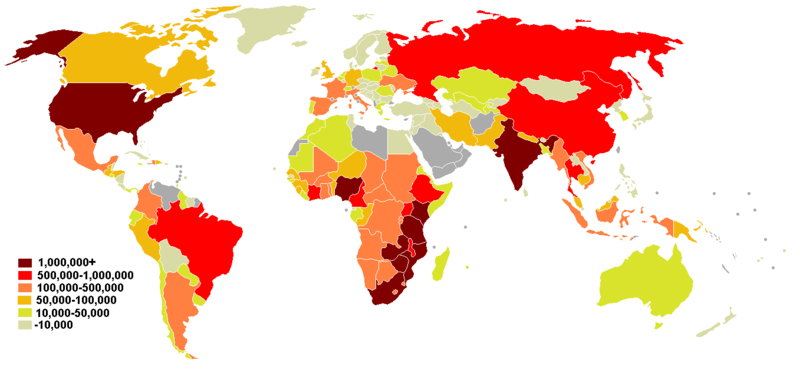
Mapping Preventable Outbreaks via @CFR

I completely forgot to show this in class after we played Pandemic. I wanted to put this up for discussion as we debriefed on the game in order to highlight the similarities between what you experienced in the game and the map of preventable outbreaks around the world. Please click on the map tab on the upper-left hand side of the interactive below and play around with the data. Of course,  you could also use this data as you seek to craft your response to your Paper 2-type question, Discuss how the threat of disease is both a local and global concern 

IB Glopo Paper 2-type Question: Global Public Health

Today, Year 1 folks and I will begin tackling our first Paper-2 type question. We’ll use class time over the next week and a half, as well as any time outside that we deem fit, to: critically appraise the question, consider approaches to answering the question, pool information from material we have covered in class, investigate new information if necessary, outline responses to the prompt, draft and revise the responses, submit them for feedback, and then debrief on our work in light of the Paper 2 markbands. Given that we have more than 7 hours to do this, we should be all set to finish these around the 21st or 22nd of November. Our prompt is below


Discuss how the threat of disease is both a local and global concern


As we work together in class, please consider the following questions below. As teams, please craft your responses to each of these questions and post them as replies to this blog post:
  1. In what ways can I answer the prompt?
  2. What concepts need to be defined?
  3. What information/data/evidence/experience can I draw upon?
  4. How could I structure my response?
  5. What tools can I use to articulate or amplify my claims?
Once we've finished with this exercise, you'll want to look at both the Assessment Objectives and Markbands for the question. Use these as a frame of reference as you seek to organize the material you provided to the questions above. 

Finally, please be sure that you are (a) crafting your response to the prompt in Google Drive and (b) sharing this document with me. I'd like to have all of your responses by Friday the 22nd of November. However, since term grades are due on 3 December (a monumental day for birthdays in the history of music as well as the study of world politics at prep schools in South Florida), you can take an additional day or two of your break to finalize your responses. As always, I'll provide feedback to all of you who share responses with me. 

Assessment Objectives
  • (AO1) I will demonstrate my knowledge and understanding of global public health within the context of what I have learned in the Power, Sovereignty, and International Relations unit. 
  • (AO2) I will apply my knowledge and understanding of the subject matter in an analytical fashion. 
  • (AO3) I will synthesize different material and evaluate information and evidence from different perspectives towards addressing the prompt.
  • (AO4) I will select, use and apply a variety of the skills and techniques I have learned such as APA format for my sources or Levels of Analysis towards addressing the prompt. 
Markbands
MarksLevel Descriptor
0
The work does not reach a standard described by the descriptors below.
1-5
The response reveals limited understanding of the demands of the question.
The response is poorly structured, or where there is a recognizable essay structure there is minimal focus on the task.
There is little relevant knowledge, and examples are either lacking or not relevant.
The response is mostly descriptive.
6-10
The response indicates some understanding of the demands of the question.
There is some evidence of an attempt to structure the response.
Some relevant knowledge is present, and some examples are mentioned but they are not developed or their relevance to arguments is not clear.
The response demonstrates limited understanding of fundamental political concepts and approaches.
There is limited justification of main points.
Counterclaims are not considered.
11-15
The demands of the question are understood and mostly addressed but the implications are not considered.
There is a clear attempt to structure the response.
The response is mostly based on relevant and accurate knowledge of global politics, and relevant examples are given and support arguments.
The response demonstrates some understanding of fundamental political concepts and approaches.
Many of the main points are justified and arguments are largely coherent.
Some counterclaims are considered.
16-20
The demands of the questions are understood and addressed, and most implications are considered.
The response is well-structured.
The response demonstrates relevant and accurate knowledge and understanding of global politics, and relevant examples are used in a way that strengthens arguments.
The response demonstrates a good grasp of fundamental political concepts and approaches.
All or nearly all of the main points are justified and arguments are coherent.
Counterclaims are explored.
21-25
A very well structured and balanced response that addresses the demands and implications of the question.
Comprehensive knowledge and in-depth understanding of global politics is applied in the response consistently and effectively, with examples integrated.
The response demonstrates a very good grasp of fundamental political concepts and approaches.
All of the main points are justified. Arguments are clear, coherent and compelling.
Counterclaims are explored and evaluated.

04 November 2013

The geopolitical challenge of malaria


Today IB Glopo Year 1 embarks on our final case study in Global Public Health; that of malaria. One half of the world's population, over 3 billion people, are at risk of contracting malaria; well over 200 million individuals contracted the disease in 2010, with over 600,000 deaths (WHO). And yet, the challenge of treating the disease is not simply one of medicine; its politics, financing, development, geography, culture, and more. As a result, the study of malaria as a geopolitical challenge is an appropriate capstone to our course of study.

We'll begin by watching Bill Gates' keynote on the subject. This will be followed by teams of students navigating a webquest on malaria. Please note that you'll need a hard copy of this reporting sheet to document your data and as a frame of reference for further analysis. We'll then play Malaria in Wazuzu as a vehicle to understand the complexities of treating malaria in a developing country. Finally, we'll have the chance to see some solutions to malaria in action. Of course, we'll debrief regularly throughout the process; this means that we should plan on at least a a week or so to work through all of this material. The complete plan for this lesson can be found here; be sure that you add this to your files as well.

09 October 2013

IB Glopo, the politics of global health, and HIV/AIDS


HIV/AIDS arguably represents the broadest, most widely-know pandemic of the 20th and 21st century. As an extension of our work on the politics of global public health, we'll watch the documentary and explore the resources from the Frontline documentary, The Age of AIDS. As we watch the documentary, please consider (at least) these questions and analytical tools as you attempt to explain or to understand the geopolitics of HIV/AIDS:

Questions Related to Key Concepts
  • Which actors have power and influence in the process? What sort of power and influence do they have? 
  • Do what extent (if any) does the principle of sovereignty impact the spread and treatment of HIV/AIDS?
  • In what way have governments, international organizations, or other actors engaged in cooperation to address the global challenge of HIV/AIDS?
Levels of Analysis
  • How can you employ Levels of Analysis to explain any of the global political issues related to HIV/AIDS at the Individual, State, or System level?
IR Theory
  • How can any branch of IR Theory-Realism, Liberalism, or Constructivism-explain any of the global political issues related to HIV/AIDS?
    • For example, consider the way in which the association of HIV/AIDS with a particular Caribbean country had an impact on this country's tourism or trade industries. 
Game Theory
  • Who are the actors in any of the political situations recounted in the documentary?
  • What are these actors' preferences in any of the political situations recounted in the documentary?
  • What strategies do these actors employ in pursuit of their preferences or interests?
Finally, you may want to read either of the articles below. Please feel free to create a Google Document and answer the following prompt: How does the author(s) frame the issue (or issues) in terms of a geopolitical challenge or conflict? What solutions does the author(s) provide? To what extent do these seem reasonable? Please feel free to share this document with me through Google Docs; I will provide feedback to anyone who shares their work with me.


02 October 2013

Pandemic comes to IB Global Politics...and iOS


One of my favorite board games, and a part of of our unit on Global Public Health (in Power, Sovereignty, and International Relations), Pandemic is now available for the iPad. I haven't seen pricing yet The game will cost you $6.99 and is definitely a game worth owning. I have several copies of the board game for play in class; however, anyone who's looking for a complex and fun (but not easy) game should have a go. 


27 September 2013

IB Glopo HL1: Work for the week, 30 Sept through 7 October


Hi folks. Here's an outline of the items you should be working on while I'm at the IB offices in The Hague. As a bit of local trivia, the IB offices are next door to the International Criminal Tribunal for the Former Yugoslavia and just down the road from the Organization for the Prohibition of Chemical Weapons; tourist stops in their own right (or at least for me, but I digress). Here's a guide for what should occupy your time this week:


Of course, I'm always up for a Google Hangout if you want to check in, get a quick video tour of the IB offices, etc. We're 6 hours ahead in The Hague. If anyone is interested, I can see if I can pop out for a quick break around 10.30 your time on Tuesday, Thursday, and Friday. I will be back stateside late on the 6th, but jet lag will most likely preclude me from being at school that day. Heb een geweldige week!

/C