Inquire

Showing posts with label current events. Show all posts

26 February 2014

IB Global Politics: Examples of signaling and coercive diplomacy

'morning folks. We have some real gems to work with in the news today. First up, Russian President Putin has ordered military exercises in the western Russia. Along with the drills, which are scheduled to last through the weekend, the Reuters article pains a comparison between statements offered by Russian PM Medvedev regarding Russian interests under threat in Ukraine and those then-President Medvedev made before invading Georgia in 2008. 

The second case involves a suspected Israeli air strike on Hezbollah military targets in the Bekaa Valley, southern Lebanon. A Hezbollah spokesperson claimed that the attack violated the sovereignty of Lebanon. In contrast, Israeli PM Netanyahu reiterated his claim to protect Israel's security.

Both examples are consistent with Thomas Schelling's concept of coercive diplomacy. Neither Russia nor Israel are relying on their military actions or signals to deter the activities of others; western-oriented Ukrainians, NATO, the EU, and the US in the former case, Hezbollah and Iran in the latter. Rather, the threat and (possible) use of force is used by actors to compel adversaries into changing their behavior. The Russian position may be that they are willing to use force to protect their perceived interests in Ukraine. This is not to deter action on the part of NATO/EU/US as none of those entities would use force in the first place. The audience for Russia's military signals may very well be oriented towards Ukrainian politicians and citizens as a reminder that current and future political decisions about the future of the Ukraine have consequences. 

Interestingly, this notion of coercive diplomacy is even extended to the actions of non-state actors. The BBC article quotes Eyal Ben-Reuven, a former deputy head of the Northern Command in Israel as saying that. "Israel has always stayed as the main objective for Hezbollah and Iran...a terror organization gets these kinds of capabilities not for deterrence, but for acts." Hezbollah's pursuit of advanced weaponry, long range rockets, and other offensive capabilities are not designed to deter Israeli actions but to compel it into submission, defeat, and/or destruction. From the Israeli perspective, Hezbollah may not be able to be deterred into a defensive posture, especially with the backing of Iran. Consequently, the (probable) Israeli use of force on Hezbollah targets is designed to signal to Hezbollah, its allies in the Assad regime and in Tehran that the strategy of pursuing advanced offensive weapons will be met with force. 

Those of you with interest in the latter topic would be well served to read Rapp-Hooper, M. (2014, February 25). How does the nuclear deal with Iran affect Hezbollah and its regional influence? Council on Foreign Relations. Retrieved from http://goo.gl/J8JmJo 

20 February 2014

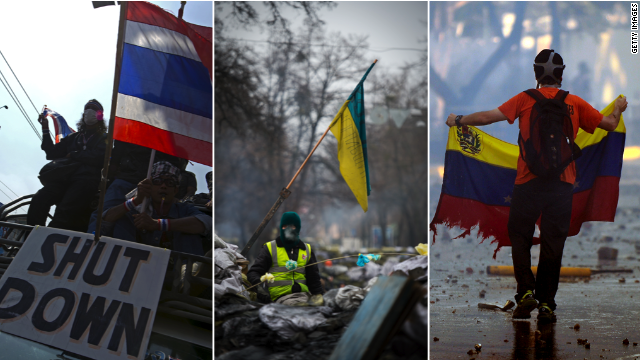
IB Global Politics: A primer on protests in Thailand, Ukraine, and Venezuela.


  1. Calamur, K. (2014, February 19). 4 Things To Know About What's Happening In Ukraine. NPR. Retrieved from http://www.npr.org/blogs/parallels/2014/02/19/279673384/four-things-to-know-about-whats-happening-in-ukraine
  2. Growing instability in Thailand. (2014). Council on Foreign Relations. Retrieved from http://www.cfr.org/global/global-conflict-tracker/p32137#!/?marker=31
  3. Kurlantzick, J. (2014, February 20). Behind a pattern of global unrest, a middle class in revolt. Business Week. Retrieved from http://www.businessweek.com/articles/2014-02-20/behind-a-pattern-of-global-unrest-a-middle-class-in-revolt 
  4. Political unrest in Ukraine. (2014). Council on Foreign Relations. Retrieved from http://www.cfr.org/global/global-conflict-tracker/p32137#!/?marker=32
  5. Political crisis in Venezuela. (2014). Council on Foreign Relations. Retrieved from http://www.cfr.org/global/global-conflict-tracker/p32137#!/?marker=29
  6. Shoichet, C. E., Olarn, K., Mortensen, A., & Zdanowicz, C. (2014, February 20). From flames to fiery opposition, protests rock Ukraine, Venezuela, Thailand. CNN. Retrieved from http://edition.cnn.com/2014/02/18/world/world-protests-explainer/index.html?sr=tw022014threeprotests115p
  7. Stagnant revolution. (2014, February 22). The Economist. Retrieved from http://www.economist.com/news/asia/21597000-protests-continue-how-much-longer-stagnant-revolution 
  8. Why is Ukraine in turmoil? (2014, February 19). BBC News. Retrieved from http://www.bbc.co.uk/news/world-europe-25182823


03 February 2014

IB Global Politics: Monday Current Events

"Do citizens have a moral obligation to overthrow an unjust government?"

Mondays have become particularly interesting in the Year 1 class of IB Global Politics. A few months back, the students asked if we could dedicate one day per week towards the discussion of current events. We came up with a plan where the students themselves would lead the discussion or activity, as well as choose a set of articles from different sources based on the previous week's news. This plan has led to Mondays becoming everything from a conventional, Harkness-style seminar to game based play on the week's news. Today's class sustained the trend to "be different" as we ran an abbreviated debate on whether citizens have a moral to overthrow an unjust government. The class was led by three students who are also active in our school's debate team; they also planned the format, facilitated the rounds, and managed the fist phase of debriefing. From an instructional perspective, I was able to work the room to listen to students ideas, answer questions, and run the "meta" debrief on the process itself. What I find most appealing about classes like this is the quality of thinking that occurs when students take on the opportunity to design, facilitate, and then reflect on their learning. My guidance came in the form of providing feedback to the students on how they can improve their ideas or the need to incorporate real world examples into their argumentation. However, the real learning comes from the students themselves in the way they themselves construct their learning environments, basis for and modes of inquiry, and how they report and evaluate their own and their colleagues learning through discussion and action. Well done!


31 January 2014

IB Global Politics HL1: Current Events for Monday 3 February

"Do citizens have a moral obligation to overthrow an unjust government?"

Facilitators

  • Amber
  • Carissa
  • Katelin

Flow

  1. Randomly divide class into pro and con teams
    1. Rock-paper-scissors-lizard-spock determines which team goes first
  2. 10 minutes prep time
    1. Decide on the number of arguments
    2. Decide on the number of representatives
    3. Example: 5 arguments requires 5 representatives to speak
  3. One team presents their arguments, followed by a moderated question period
  4. Second team presents their arguments, followed by a moderated question period
  5. Both teams offer rebuttal arguments
  6. Both teams offer closing statements
  7. 10 minute debrief time; use this PollEverywhere
    1. How do you feel?
    2. What happened?
    3. What did you learn?
    4. How did this relate to the real world?
    5. What if?
    6. What's next?

Current Events


Resources


27 January 2014

Happy MUNday from Den Haag

This year's THIMUN kicks off this morning at the Novatel World Forum, right across the street from our offices here at the IB  (I'll send pictures later). In any event, three news stories popped up this morning from NPR and the New York Times; one for the Glopo HL1 folks and two for the HL2 folks. HL2, please take the opportunity to play with the interactive predictor from the NYT-its fascinating. Please use your time today and tomorrow to read or listen to the following:


13 January 2014

IB Global Politics: Current Events Dodgeball

Our Monday morning current events briefing became a lot more competitive this week. Today's articles from the BBC, The Economist, and the UN News Centre covered the removal of chemical weapons from Syria. The Year 1 folks did a great job in facilitating & participating in a game of intellectual dodgeball (thanks @thiagi) to parse through the material found in the articles. While the game itself was fun to observe and participate in, the best part of the class (as always) was the debriefing. Specifically, students felt that the rules of the game were such that everyone had to focus on generating fact based questions at the expense of asking analytical, higher order questions. Students suggested that we revise the game for future use to include mechanics that would incentivize the creation of more complex questions to answer and debate, rather than simply try and see who-could-stump-who with random trivia from the weeks events. This is exactly the sort of thinking that's consistent with findings on student engagement. Students prefer tasks that are behaviorally stimulating, emotionally supportive, and cognitively challenging. Our task as instructors and facilitators is to provide students these opportunities each and every day, let our learners explore and play with new experiences, and then help them to make sense of what they've learned through reflection and debriefing. Next week's current events briefing may have a completely different set of mechanics and flow, but I'm sure that the students will chose something equally if not more engaging to play with.


10 January 2014

IB Glopo HL1: Current Events Roundtable for Monday, 13 January

Facilitators
Loredana, Jay, and Kristina

Prompt
Discuss the legitimacy of global approaches to addressing the challenge of chemical weapons. 

Readings
  1. Germany to help destroy Syria chemical weapons. (2014, January 9). BBC News. Retrieved from http://www.bbc.co.uk/news/world-middle-east-25664162
  2. Security Council expects Syria to meet June deadline for chemical weapons removal, official says. (2014, January 8). UN News Center. Retrieved from http://www.un.org/apps/news/story.asp?NewsID=46888
  3. The history of chemical weapons. (2013, August 31). The Economist. Retrieved from http://www.economist.com/news/briefing/21584397-how-whole-class-weaponry-came-be-seen-indecent-shadow-ypres?zid=312&ah=da4ed4425e74339883d473adf5773841 

06 December 2013

IB Glopo Year 1: The ICRC and humanitarian assistance

Week of 9-13 December


Suggested readings
  1. International Committee of the Red Cross. (2009). The ICRC: Its mission and work [Brochure]. Author. Retrieved from http://www.icrc.org/eng/assets/files/other/icrc_002_0963.pdf 
  2. International Committee of the Red Cross. (1994, December 31). Code of Conduct for the International Red Cross and Red Crescent Movement and Non-Governmental Organizations (NGOs) in Disaster Relief (Rep.). Retrieved from http://www.icrc.org/eng/assets/files/publications/icrc-002-1067.pdf 
  3. International Committee of the Red Cross. (2013, May). Annual Report: 2013 (Rep.). Retrieved from http://www.icrc.org/eng/assets/files/annual-report/icrc-annual-report-2012.pdf
    1. For reference only; this report is more than 500 pages in length. 


04 December 2013

IB Global Politics HL1: Monday

Its finally here-what you’ve been waiting for (apparently…you have nothing better to do?). Below is my set of ideas to get our current events discussions off the ground. I dabbled with the idea of presidential briefings or conducting a shadow UN on Twitter, but in the end I went for the easy. Of course we can do those other two if everyone is on board. In any event, we’ll take a look at this in class on Friday. Until then, please read through this document and please let me know what looks good, what will not work, and/or what’s missing.

---

The Monday Current Events Briefing

Each week, IB Global Politics HL1 will dedicate one day of class time to discuss and analyze contemporary geopolitical affairs. At the start of a previous class period, your table will choose a region at random (names in a hat, deck of cards, rock-paper-scissors-lizard-spock, etc.). Each person at the table will then scour the list of courses (below) to find the most fantabulously interesting article on world politics for the week. As you read it, please  develop a set of notes, an outline, or a set up talking points that addresses each of the following:


  • Summary: Craft a two to three sentence synopsis of your chosen article. 
  • Connection: How are the ideas and information in the article connected to what you already know? How does this article relate to your wider study of global politics?
  • Extension: What new ideas did you encounter that extended or pushed your thinning in new directions? Are you able to answer the “so what?” question for this article?
  • Challenge: What do you still find challenging or confusing for you to get your head around? What questions, wonderings, or puzzles about the topic do you still have?


Each Monday, we’ll open a speakers list for the day. Please note that once you have presented your article, you won’t be able to do so again in a subsequent class until we we have exhausted the speakers list. As you listen to your colleagues discuss their article and analysis, please listen thoughtfully and consider one or two questions that you wish them to address as it relates to world politics. Finally, one speaker each week will be chosen through voting, or lottery, or by arbitrary fiat from the benevolent classroom dictator for the day to post their analysis on the blog. This lucky individual will then choose two of their colleagues to provide their own commentary and insight on the article in the form of comments to the blog post. Our hope is that we can use these briefing sessions to amplify and extend our knowledge of world politics in a discursive and constructive fashion. 

Suggested Sources


02 September 2013

Getting students ready for the week ahead (via The Economist)


'evening all. I hope everyone had a restful weekend. Thanks to those of you who sent me your ideas on the Snyder (2004) and the Kyl, Feith, and Fonte (2013) articles. I'll get you your feedback this week. In the interim, please enjoy some good analysis from our friends at The Economist. 

23 August 2013

IB Glopo students: listen to The World Next Week


'morning folks. Please take the time (only about 20 minutes) today or this weekend to listen to The World Next Week podcast from the Council on Foreign Relations. You can also subscribe to this podcast-great to listen to while at the gym-from iTunes by clicking here.